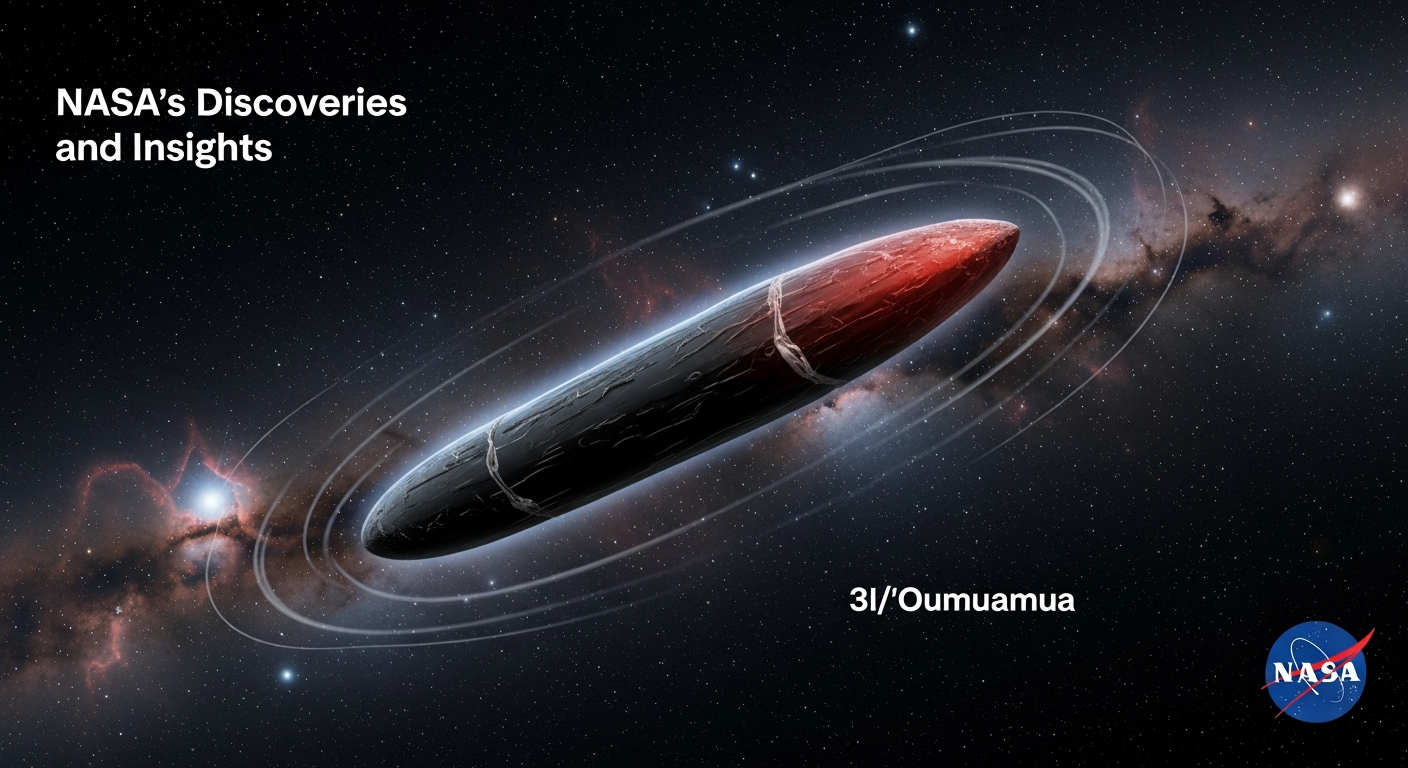

The discovery of Interstellar Comet 3I/‘Oumuamua objects in our solar system has revolutionized our understanding of the cosmos. Among these objects, the interstellar comet 3I/‘Oumuamua, also identified through the ATLAS survey and studied by NASA, stands out for its unique characteristics and origin beyond our solar system. This article delves into the significance of 3I/‘Oumuamua, the role of NASA and ATLAS in its discovery, and what it tells us about the universe.
What is Interstellar Comet 3I/‘Oumuamua
3I/‘Oumuamua, pronounced “oh-MOO-ah-MOO-ah,” is the first confirmed interstellar object detected passing through our solar system. Unlike comets that originate from the Oort Cloud or Kuiper Belt within our solar system, 3I/‘Oumuamua came from outside, making it an interstellar visitor. Its designation “3I” indicates that it is the third interstellar object officially recognized, with “I” standing for interstellar.
Unlike typical comets, 3I/‘Oumuamua did not have a prominent tail, making its behavior peculiar. Its elongated, cigar-like shape, rotation, and tumbling motion captured the attention of astronomers worldwide. The object’s surface appeared reddish, suggesting it had been exposed to cosmic radiation for millions of years. These features made 3I/‘Oumuamua one of the most mysterious objects observed in modern astronomy.
NASA’s Role in Studying 3I/‘Oumuamua
NASA played a crucial role in monitoring and studying 3I/‘Oumuamua after its discovery. Using a network of telescopes, including the Hubble Space Telescope, NASA scientists tracked its trajectory, analyzed its composition, and studied its unusual acceleration as it passed near the Sun.
The unexpected acceleration, which could not be explained solely by gravitational forces, suggested that outgassing or another non-gravitational force might be at work. However, the lack of visible gas emissions led to various hypotheses, including the possibility of 3I/‘Oumuamua being a fragment of a larger interstellar body, a thin sheet-like object, or even a natural phenomenon not yet fully understood.
NASA’s interest in interstellar objects extends beyond 3I/‘Oumuamua. Understanding such visitors can provide insights into planetary systems outside our own, including how planetary formation occurs in other parts of the galaxy. The detection of interstellar comets encourages the development of missions to intercept or study these objects up close in the future.
The ATLAS Survey and Its Contribution
The Asteroid Terrestrial-impact Last Alert System (ATLAS) is a vital survey system that scans the sky to detect near-Earth objects and other celestial phenomena. Located in Hawaii, ATLAS uses wide-field telescopes to capture images of the night sky multiple times a night. Its goal is to identify objects that might pose a threat to Earth, but it also plays a role in discovering unusual or rare objects, such as interstellar comets.
3I/‘Oumuamua was detected by the ATLAS system in October 2017. The initial discovery triggered a global observational campaign, with astronomers around the world collecting data on its trajectory, brightness, shape, and rotation. Without ATLAS’s rapid detection capabilities, 3I/‘Oumuamua might have passed through the solar system unnoticed, highlighting the importance of advanced survey technologies in modern astronomy.
The Journey of 3I/‘Oumuamua Through the Solar System
3I/‘Oumuamua’s journey through the solar system was brief but remarkable. Its hyperbolic trajectory indicated that it was not bound by the Sun’s gravity and would continue traveling through interstellar space after leaving our solar system. Scientists calculated that the object entered our solar system at a speed of approximately 315,000 kilometers per hour (196,000 miles per hour).
The object’s path provided a unique opportunity to study material from outside our solar system. By analyzing its light curve and motion, astronomers inferred its shape and surface properties. 3I/‘Oumuamua’s elongated form, unusual for a comet, led to numerous debates and inspired new models of interstellar object dynamics.
Composition and Physical Characteristics
Observations of 3I/‘Oumuamua suggest that it is primarily composed of rock, metal, and possibly frozen volatiles, similar to asteroids in our solar system but with significant differences. Its reddish color points to prolonged exposure to cosmic radiation, which alters the chemical composition of the surface.
Despite its classification as a comet, 3I/‘Oumuamua did not display the typical icy tail seen in other comets, which puzzled scientists. Some theories suggest that it may have a thin layer of volatile-rich material beneath a hard surface, causing non-gravitational acceleration without visible outgassing. Its rotation, estimated to be once every 7.3 hours, showed complex tumbling behavior, further adding to the mystery.
Scientific Implications of 3I/‘Oumuamua
The discovery of 3I/‘Oumuamua has profound implications for science. Firstly, it confirmed that interstellar objects can and do travel through our solar system, providing a rare opportunity to study material formed in distant star systems. Secondly, its unusual properties challenge conventional understanding of comet and asteroid formation.
The study of 3I/‘Oumuamua also fuels speculation about the diversity of objects in the galaxy. It suggests that interstellar material might be more common than previously thought and that our solar system may frequently encounter visitors from afar. Such encounters could provide natural laboratories to study the building blocks of other planetary systems and the chemistry of interstellar space.
Future Missions and Research
NASA and other space agencies are now considering missions specifically designed to intercept or observe interstellar objects in the future. These missions would aim to capture high-resolution images, analyze surface composition, and even return samples to Earth. The brief but intensive study of 3I/‘Oumuamua has laid the groundwork for such endeavors.
By understanding the origins, composition, and dynamics of interstellar comets, scientists can answer fundamental questions about the formation of planetary systems, the distribution of matter in the galaxy, and the potential for life elsewhere. Every interstellar visitor offers a rare glimpse into a distant corner of the universe, making each discovery invaluable.
Public Interest and Cultural Impact
3I/‘Oumuamua also captured the imagination of the public and media. Its unusual shape and origin inspired discussions not only in scientific circles but also in popular culture. Some speculated about its artificial origin, though there is no evidence to support such claims. The object became a symbol of humanity’s growing ability to observe and understand the universe in unprecedented detail.
Public fascination with 3I/‘Oumuamua highlights the broader importance of space exploration. Discoveries like this bridge the gap between professional science and public curiosity, encouraging education, funding, and global cooperation in astronomy.
Conclusion
The interstellar comet 3I/‘Oumuamua represents a milestone in astronomical discovery. Detected by the ATLAS survey and studied extensively by NASA, this mysterious object challenges our understanding of the cosmos. Its unusual trajectory, shape, and composition provide a glimpse into material from beyond our solar system, offering insights into the formation of other planetary systems and the diversity of the universe.
As technology improves and survey systems become more sophisticated, more interstellar visitors will likely be discovered. Each object will bring unique information about the galaxy, allowing scientists to expand humanity’s understanding of the cosmos and our place within it. 3I/‘Oumuamua reminds us that the universe is vast, mysterious, and full of surprises, waiting for curious minds to explore.
FAQs
What is 3I/‘Oumuamua?
3I/‘Oumuamua is the first confirmed interstellar object detected passing through our solar system, originating from outside the Sun’s gravitational influence.
How was 3I/‘Oumuamua discovered?
It was discovered in October 2017 by the ATLAS survey in Hawaii, which monitors the sky for asteroids and other unusual celestial objects.
Why is 3I/‘Oumuamua considered unusual?
Its elongated shape, tumbling rotation, lack of a visible comet tail, and unexpected acceleration make it distinct from typical comets and asteroids.
What role did NASA play in studying it?
NASA used telescopes such as Hubble to track its trajectory, analyze its composition, and study its unusual motion to better understand interstellar objects.
Will we see more interstellar objects in the future?
Yes. Advances in survey systems like ATLAS and upcoming space missions will likely detect more interstellar visitors, providing further insight into the galaxy beyond our solar system.